- 中文网站请点击 http://www.pinxinggroup.com
-
 +86-21-57566731
-
 cai@pinxingmotor.com
-
 DOWNLOAD


 English
 русский
 Français
 عربى
عربى
10 HP Electric Motor 3 Phase: Full Load Current, Frame Sizes and IE4 Guide
Content
- 1 What 10 hp electric motor 3 phase ratings mean on a nameplate
- 2 Full load current: the number that sizes a 10 hp electric motor 3 phase circuit
- 3 IE3 or IE4: what an efficiency class is worth at 7.5 kW
- 4 NEMA 215T against IEC 132M: the mounting trap
- 5 Starting current and protection for a 10 hp three-phase motor
- 6 Specification checklist before you order a 10 hp motor
- 7 Frequently asked questions about 10 hp three-phase motors
A 10 hp electric motor 3 phase draws 28 A at 230 V, 14 A at 460 V and about 15 A at 400 V. All four figures describe the same 7.5 kW of shaft output, and each one points to a different cable, contactor and overload setting.
Shaft output and electrical input are two different numbers. A 10 hp motor produces 7.46 kW of mechanical power at its shaft when fully loaded, while the power it consumes at the terminals is higher because no machine converts electricity to torque at 100 percent efficiency. The current it pulls depends on supply voltage as much as on load. Installers who read "10 hp" as an electrical figure are the ones who order a 16 A contactor for a motor that draws 28 A.
This guide covers the four decisions that determine whether a 10 hp motor runs for fifteen years or fails in its first year: full-load current, frame and mounting dimensions, efficiency class and starting method. The reference data comes from NEC Table 430.250 and IEC 60034-30-1. For a wider view of how low-voltage machines are specified and protected, the low voltage motor selection guide covers efficiency classes, protection and drive integration in more depth.
What 10 hp electric motor 3 phase ratings mean on a nameplate
A 10 hp three-phase motor delivers 7.5 kW of mechanical power at its shaft, and every other value printed beside it explains how that output is produced.
The conversion is the first thing to fix in your head: 1 hp equals 0.746 kW, so 10 hp is 7.46 kW. IEC rounds the same rating to 7.5 kW, which is why a European nameplate and a North American nameplate describe an identical machine. Beyond output, the plate carries the numbers that matter at the purchasing desk: rated voltage, frequency, full-load amps, power factor, efficiency class, duty, insulation class, maximum ambient and enclosure type.
Pole count decides speed and torque, and it carries the largest mechanical consequences of any single choice:
| Pole count | Speed at 50 Hz | Speed at 60 Hz | Torque at rated output | Typical NEMA frame | Typical IEC frame |
| 2 pole | 3000 rpm | 3600 rpm | 23.9 Nm | 215T | 132S |
| 4 pole | 1500 rpm | 1800 rpm | 47.8 Nm | 215T | 132M |
| 6 pole | 1000 rpm | 1200 rpm | 71.6 Nm | 254T | 160M |
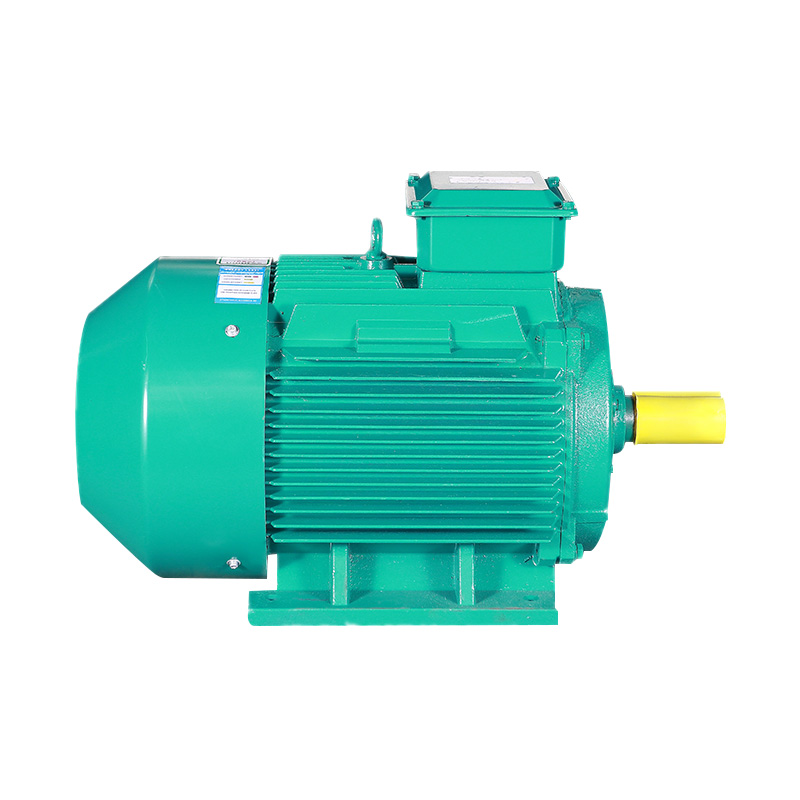 IE3 Series Three-Phase Induction Motor H80-355MM FramesHigh-efficiency IE3 induction motor in H80-355MM frames with 2-12 poles and 0.75-355 kW output, suited for continuous industrial drives where speed and torque choices matter.View Product →
Torque follows the pole count. At 7.5 kW a four-pole machine produces about 47.8 Nm, while a six-pole machine produces about 71.6 Nm at two thirds of the speed. That extra torque is often worth the larger frame, because it removes a belt drive or a gear reducer from the train and eliminates a wear point.
Two nameplate details cause real disputes. A NEMA motor usually carries a 1.15 service factor, which is a short-term overload allowance rather than a licence to run continuously at 115 percent of rating. IEC machines normally state a service factor of 1.0 and declare duty as S1, S2 or S3. A 10 hp motor selected for intermittent duty and then run around the clock will overheat its winding long before its bearings give trouble.
Full load current: the number that sizes a 10 hp electric motor 3 phase circuit
Full-load current is the amperage a 10 hp three-phase motor draws at rated voltage, frequency and output, and it sets the rating of the cable, the contactor, the overload relay and the branch-circuit protection.
DefinitionFull-load current (FLC) is the current drawn at rated voltage, rated frequency and rated output, measured at the motor terminals. It is a design figure rather than a measured one, and it is the basis for every conductor and protection decision on the circuit.
Current rises as supply voltage falls, because power is the product of voltage, current, power factor and efficiency. A 10 hp motor that pulls 14 A at 460 V pulls twice that at 230 V:
Full-load current of a 10 hp (7.5 kW) three-phase motor by supply voltage
Values at 208, 230, 460 and 575 V come from NEC Table 430.250; the 400 V figure is a typical IE3 four-pole nameplate value and varies by manufacturer.
| Supply | Full-load current | Reference |
| 208 V, 60 Hz | 30.8 A | NEC Table 430.250 |
| 230 V, 60 Hz | 28 A | NEC Table 430.250 |
| 400 V, 50 Hz | 15.0 to 15.5 A | Typical IE3 four-pole nameplate |
| 460 V, 60 Hz | 14 A | NEC Table 430.250 |
| 575 V, 60 Hz | 11 A | NEC Table 430.250 |
North American practice splits the calculation in two. Conductor ampacity and short-circuit protection are sized from the table value of full-load current raised by 125 percent for continuous duty, so a 230 V motor needs a design current of 35 A and an 8 AWG copper conductor at 75 C. Overload protection works differently: the relay is set from the nameplate full-load amps, which is why a 400 V machine showing 15 A on the plate should have its thermal trip set at 15 A.
Contactor selection deserves the same care. Choose a device rated for AC-3 utilisation at the motor current rather than one quoted at AC-1, because a contactor sold as a 20 A unit may only be good for 9 A when it is actually switching a motor.
IE3 or IE4: what an efficiency class is worth at 7.5 kW
For a 7.5 kW four-pole motor, IE3 efficiency is about 91 percent and IE4 about 92.4 percent, and at 6,000 running hours a year that gap is worth roughly 1,086 kWh.
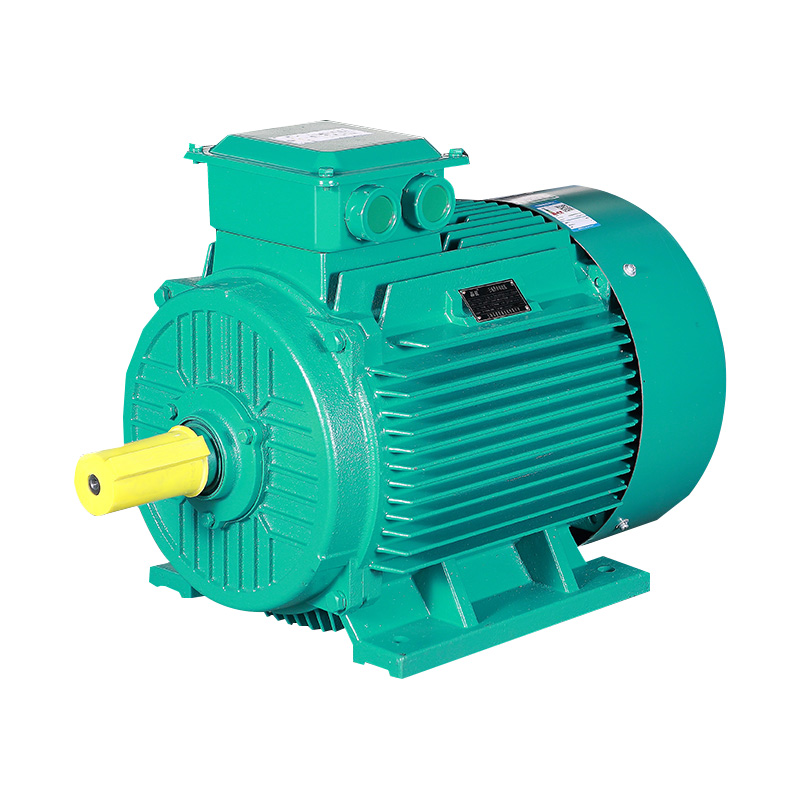 IE4 Series Three-Phase High Efficiency Induction Motor H80-355MMHigher-efficiency IE4 induction motor line in H80-355MM frames, offering 0.75-355 kW output for energy-saving industrial drives where annual running hours make efficiency gains valuable.View Product →
The arithmetic is simple once shaft output and input power are kept apart. At 75 percent load a 10 hp motor delivers about 5.6 kW at the shaft. Divide by efficiency to get the electrical input: 5.6 kW at 89.7 percent (IE2) equals 6.24 kW, and the same output at 92.4 percent (IE4) equals 6.06 kW. The 0.18 kW difference over 6,000 hours is 1,086 kWh, worth about USD 130 a year at USD 0.12 per kWh.
Efficiency classes are also a compliance question. European Regulation 2019/1781 sets IE3 as the minimum for motors from 0.75 kW to 1000 kW and raises the bar to IE4 for the 75 kW to 200 kW band, so a 7.5 kW machine sits in the IE3 tier. NEMA Premium in North America is broadly equivalent to IE3, which means a 10 hp replacement motor purchased on either continent carries a comparable efficiency floor.
Rewinding a failed 10 hp motor rarely restores its original efficiency, and the loss compounds every hour it runs. Replacing a standard-efficiency unit with an IE3 or IE4 machine in the same frame usually pays back in under three years on two-shift operation.
One caution matters more than the label. A 10 hp motor running at 40 percent of rated load sits low on its efficiency curve, and re-rating that duty to a 5.5 kW machine saves more energy than any class upgrade. Match the rating to the load before paying for a higher class.
NEMA 215T against IEC 132M: the mounting trap
A NEMA 215T frame and an IEC 132M frame both carry 10 hp at four poles, but their shafts and feet are not interchangeable, and that mismatch delays more projects than any electrical problem.
NEMA 215T
- Shaft diameter 1.375 in (34.9 mm)
- Shaft height 5.25 in (133 mm)
- 60 Hz speeds of 3600, 1800 and 1200 rpm
- Dual voltage 230/460 V with nine leads
- Service factor typically 1.15
IEC 132M
- Shaft diameter 38 mm
- Shaft height 132 mm
- 50 Hz speeds of 3000, 1500 and 1000 rpm
- Voltage 400/690 V or 230/400 V
- Service factor typically 1.0
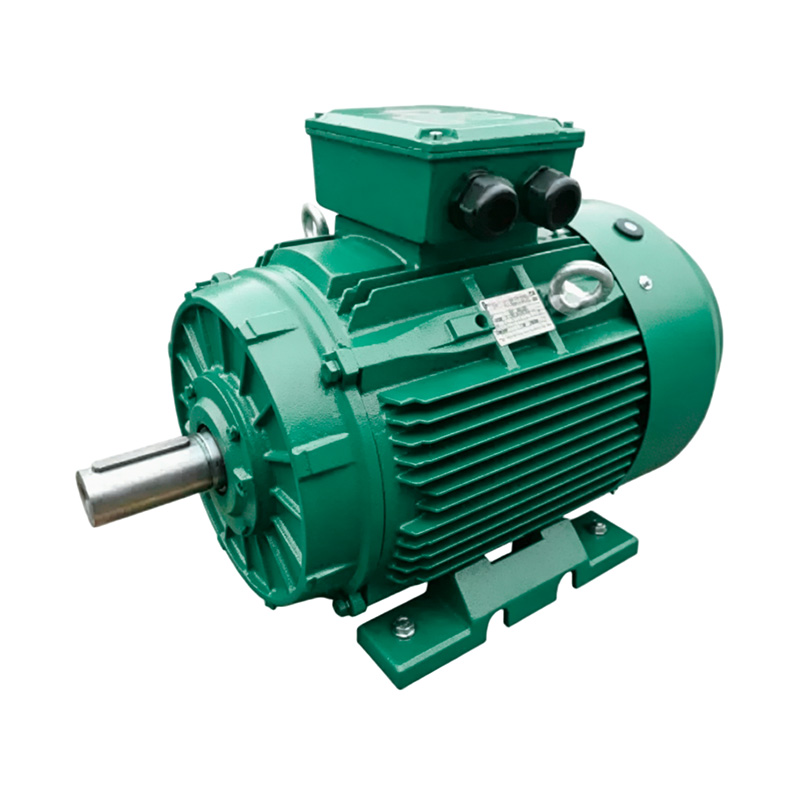 TEFC Motors in the NEMA Motor Product LineCategory hub for TEFC NEMA motor series including premium efficiency, pump, crusher, oil well, and brake models, useful when verifying frame and mounting compatibility.View Product →
The two shaft heights differ by one millimetre, which is exactly the trap: the motor drops into the bracket and then the foot holes do not line up. Always request a dimensioned drawing and verify shaft diameter, shaft length, keyway width, foot hole spacing and flange or face type before the purchase order is released.
Frequency is the second trap. A 60 Hz motor connected to a 50 Hz supply runs about 17 percent slower, and if the supply voltage stays at nameplate value the volts-per-hertz ratio rises by 20 percent, increasing flux, current and winding temperature. A 50 Hz motor pushed to 60 Hz overspeeds by the same margin and can exceed the design limits of the driven equipment.
For a 7.5 kW rating, suppliers such as Shanghai Pinxing Explosion-proof Motor Co., Ltd. build the same output in standard IEC low-voltage frames, in NEMA frames and in explosion-proof ranges, so a plant that mixes standards can be covered in a single order with matching starters and control cabinets. Reviewing application case studies before a specification is frozen is a cheap way to avoid a second order for adapter plates.
Starting current and protection for a 10 hp three-phase motor
A 10 hp three-phase motor started direct-on-line draws 6 to 8 times its full-load current, which is roughly 90 to 120 A at 400 V for the first few hundred milliseconds.
Inrush is a starting problem, not a running one. The motor only sees that current until it reaches about 80 percent of synchronous speed, so the starting method decides whether the supply voltage dips or holds.
- Direct-on-line starting uses a contactor, an overload relay and a fuse or breaker. It is the simplest and cheapest option and is acceptable where the supply is stiff and the driven load has low inertia. Expect 6 to 8 times full-load current on every start.
- Star-delta starting reduces starting current and torque to about one third of the direct-on-line values. It requires a six-lead motor and a changeover delay long enough for the motor to accelerate before the transition, otherwise the current spike at changeover can exceed the direct-on-line value.
- A soft starter ramps voltage over 5 to 20 seconds and holds starting current at 2 to 4 times full-load current with a settable limit. It suits pumps and fans where the mechanical load builds gradually with speed.
- A variable frequency drive limits current to 100 to 150 percent of full-load current and adds speed control. Specify an inverter-duty motor with class F insulation and, on larger frames, a shaft grounding ring to protect the bearings.
Protection settings follow from the same numbers:
- Set the thermal overload to the nameplate full-load amps, with trip class 10 for standard loads and class 20 or 30 for high-inertia loads such as crushers and mixers.
- Size short-circuit protection from the table full-load current, since a motor branch circuit permits a much higher breaker rating than a general-purpose circuit.
- Include phase-failure protection. A three-phase motor running on two phases will destroy its winding within minutes.
- On a drive, check the motor cable length against the manufacturer limit and add an output reactor or dv/dt filter when the run is long.
Specification checklist before you order a 10 hp motor
Six parameters decide whether a 10 hp three-phase motor fits the application, and all six should be confirmed on a dimensioned drawing before a purchase order is issued.
| Parameter | Confirm this | Common mistake |
| Power and speed | 7.5 kW at 4 poles, or the speed the driven equipment requires | Choosing 2 poles to save cost, then fighting belt wear |
| Voltage and frequency | 400 V 50 Hz or 460 V 60 Hz, plus delta or star connection | Assuming a 230/460 V NEMA motor works on a 400 V 50 Hz supply |
| Mounting | Foot (B3), flange (B5) or face (C-face), with hole spacing | Matching shaft height only and ignoring foot spacing |
| Enclosure and IP | IP55 TEFC indoors, IP65 for washdown, Ex d for hazardous zones | Using a standard TEFC motor inside a Zone 1 area |
| Insulation and duty | Class F insulation, Class B rise, S1 continuous duty | Buying S3 intermittent duty for a continuously loaded fan |
| Efficiency and certification | IE3 or IE4, plus the certification the site requires | Ordering a class the local regulation no longer accepts |
Write the six values into the inquiry and ask for a certified test report. A 7.5 kW motor is small enough that substitutions look harmless on paper, and large enough that a wrong frame stops a production line.
Frequently asked questions about 10 hp three-phase motors
How many amps does a 10 hp three-phase motor draw?
NEC Table 430.250 lists 30.8 A at 208 V, 28 A at 230 V, 14 A at 460 V and 11 A at 575 V. An IEC 7.5 kW IE3 four-pole machine on a 400 V 50 Hz supply typically shows 15.0 to 15.5 A on its nameplate. Always size conductors from the table value and set the overload relay from the nameplate value.
Can a 10 hp three-phase motor run on single-phase power?
Not directly. A rotary phase converter or a variable frequency drive can synthesise the third phase, but the drive must be sized above the motor nameplate current, often 1.5 to 2 times, and the motor should be derated because cooling and ripple current change. A 10 hp three-phase motor on a single-phase derived supply should be treated as a 7 to 8 hp machine until the manufacturer confirms otherwise.
What cable size does a 10 hp three-phase motor need?
At 230 V, 125 percent of 28 A is 35 A, which calls for 8 AWG copper at 75 C. At 460 V, 125 percent of 14 A is 17.5 A, which calls for 12 AWG copper. Long runs need upsizing to hold voltage drop within 3 percent on the branch circuit, so check the distance as well as the ampacity.
Is 10 hp the same as 7.5 kW?
Yes in practice. Ten horsepower equals 7.46 kW, and IEC builds a 7.5 kW frame for the same duty, so a European 7.5 kW motor and a North American 10 hp motor are functionally identical. Nameplate full-load amps differ by voltage, frequency and efficiency class, not by the hp or kW label.

Get in Touch
Related Products
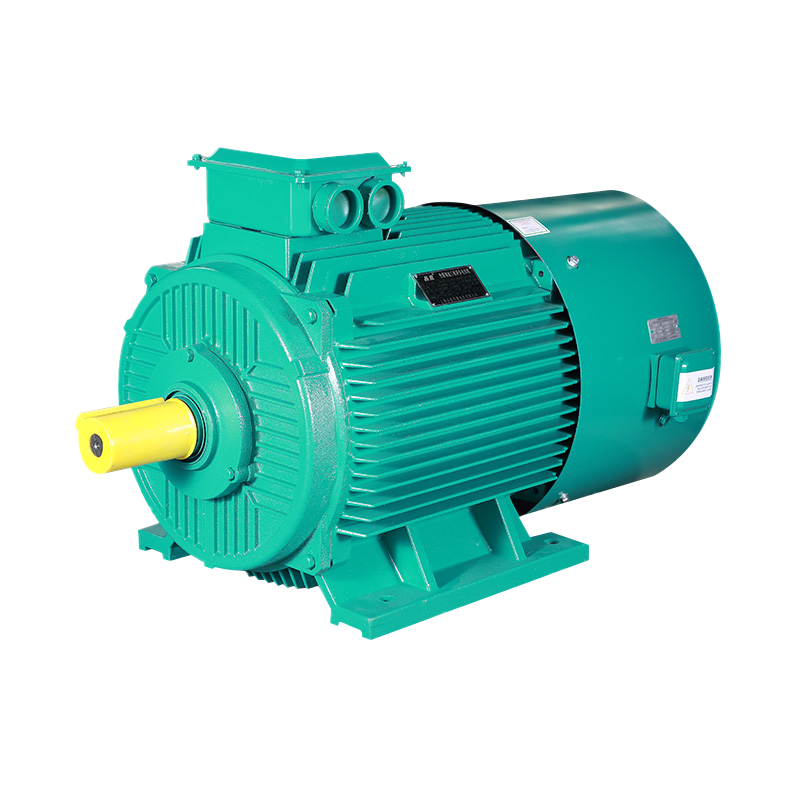
 Shanghai Pinxing
Explosion-proof Motor Co., Ltd.
-
 cai@pinxingmotor.com
-
 +86-21-57566731
-
 +86-21-57566967
-
 No.699, Pinxing Rd., Qinggang Industrial Zone, Fengxian District, Shanghai, China.(East Gate)
-
No. 168, Qingling Rd, Qinggang Industrial Zone, Qingcun Town, Fengxian District, Shanghai, China (South Gate)
Copyright@ 2024 Shanghai Pinxing Explosion-proof Motor Co., Ltd. All Rights Reserved.
Privacy