- 中文网站请点击 http://www.pinxinggroup.com
-
 +86-21-57566731
-
 cai@pinxingmotor.com
-
 DOWNLOAD


 English
 русский
 Français
 عربى
عربى
Key Differences Between Standard Motors and Variable Frequency Drive Motors
Content
- 1 1. Price Difference
- 2 2. Cooling System Difference
- 3 3. Insulation Class Difference
- 4 4. Harmonic and Loss Impact Difference
- 5 5. Electromagnetic Load Capacity Difference
- 6 6. Harmonic Electromagnetic Noise and Vibration Difference
- 7 7. Mechanical Structure and Bearing Strength Difference
- 8 8. Speed Regulation Performance Difference
- 9 9. Operational Stability and Service Life Difference
- 10 10. Application Differences
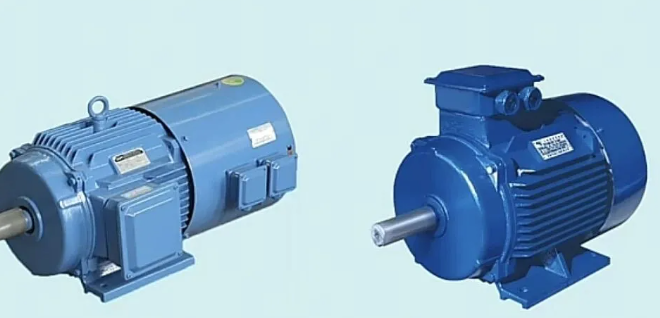
Standard motors and variable frequency drive (VFD) motors have significant differences in several aspects, mainly reflected in the following areas.
1. Price Difference
This is also obvious to everyone. VFD motors are about 50% more expensive. VFD motors have a stronger adaptability to frequency conversion. Standard motors can only operate at fixed frequencies; below 35Hz or above 60Hz, standard motors may burn out. VFD motors have a wider operating range and stronger working intensity, thus requiring more complex designs and higher-performance materials, which typically results in a higher price, while standard motors are relatively lower in cost.
2. Cooling System Difference
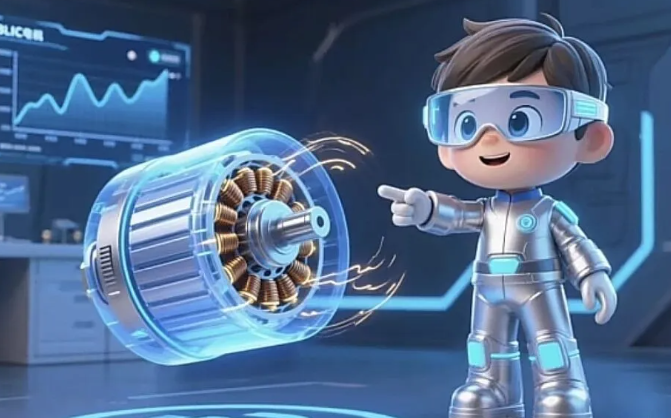
The cooling fan of a standard motor is connected to the motor shaft, relying on the motor's rotation to drive the fan. Therefore, during low-speed operation, insufficient cooling capacity may lead to overheating and burnout. The standard motor and its fan are coaxially connected; when it rotates fast, the fan speed is high; when it rotates slowly, the fan speed is low. At low frequencies and low speeds, the fan cannot deliver enough airflow, causing the motor to overheat. When a VFD motor's speed decreases, the cooling air volume decreases proportionally to the cube of the speed, making it difficult to dissipate heat, causing the temperature rise to increase sharply, and making it difficult to achieve constant torque output. VFD motors are equipped with an independent cooling fan driven by a separate motor, which can provide a constant, high volume of airflow, effectively solving the cooling problem.
3. Insulation Class Difference
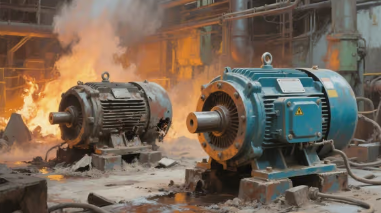
Standard motors typically use Class B insulation, which can withstand relatively lower temperatures and current surges. VFD motors, however, need to operate over a wider frequency range and higher speeds. VFD motors can operate at up to around 100Hz, or even higher, and the peak current causes significant stress. Therefore, they employ Class F insulation or even higher-grade insulation materials to withstand the damage caused by high-frequency currents and voltages to the insulation.
4. Harmonic and Loss Impact Difference
VFDs generate harmonics at different frequencies during operation. The voltage and current cause the motor to operate under non-sinusoidal voltage and current conditions. The high-frequency harmonics increase stator losses, rotor losses, core losses, and additional losses in the motor. The most significant is the rotor copper loss. These losses increase the motor's additional heat generation, reduce efficiency, and decrease output power. The temperature rise in standard motors generally increases. The VFD's carrier frequency ranges from several kilohertz to over ten kilohertz, subjecting the motor's stator winding to a very high voltage rise rate, equivalent to applying a steep surge voltage to the motor. Standard motors using conventional materials typically see a temperature rise increase of 10% to 20%, placing severe stress on the winding's turn-to-turn insulation. It is necessary to enhance the motor's ground insulation and turn-to-turn insulation strength, especially considering the insulation material's ability to withstand surge voltages.
5. Electromagnetic Load Capacity Difference
The materials used for silicon steel sheets and windings differ. Standard motors often experience magnetic circuit saturation during operation, which limits their performance under variable frequency operation. VFD motors increase the electromagnetic load, using more silicon steel sheets, higher-quality,y thinner silicon steel sheets, and optimized windings to prevent magnetic circuit saturation, allowing them to provide high torque at low speeds, thus improving motor performance and efficiency.
6. Harmonic Electromagnetic Noise and Vibration Difference
When a standard motor is powered by a VFD, the vibration and noise caused by electromagnetic, mechanical, and ventilation factors become more complex. The harmonics present in the VFD power supply interact with the inherent electromagnetic harmonics of the motor, creating various electromagnetic excitation forces that increase noise. Because the motor's operating frequency range is wide and the speed variation range is large, it is difficult for the frequencies of the various electromagnetic force waves to avoid the natural frequencies of the motor's structural components. When the power supply frequency is low, the losses caused by high-frequency harmonics in the power supply are significant.
7. Mechanical Structure and Bearing Strength Difference
VFD motors have higher bearing strength to adapt to a wider range of operating conditions, while standard motors have relatively lower bearing strength. VFD motors have stricter vibration and noise requirements. The design of VFD motors must fully consider the rigidity of the components and the overall structure, striving to increase their natural frequencies to avoid resonance with various magnetic force waves. For motors with a capacity exceeding 160KW, VFD motors should adopt bearing insulation measures. This is primarily because asymmetric magnetic circuits can generate shaft currents, and when these combine with currents from high-frequency components, the shaft current increases significantly, leading to bearing damage. Therefore, insulation measures are generally required. For constant-power VFD motors operating at speeds exceedin3000 rpm0r/min, high-temperature resistant special lubricating grease should be used to compensate for the temperature rise of the bearings.
8. Speed Regulation Performance Difference
Standard motors have a fixed speed and rely on external adjustment devices to change the speed. The speed of a standard motor is fixed by the grid frequency. In contrast, VFD motors can achieve smooth speed variation over a wide range, meeting the requirements of different operating conditions, and also offer soft-start and rapid braking functions. VFD motors support 0 to 100% stepless speed regulation.
9. Operational Stability and Service Life Difference
When driven by a VFD, standard motors experience significant harmonic interference. VFD motors reduce voltage output differences and noise through optimized electromagnetic design. VFD motors use special bearings and anti-aging materials, resulting in a service life extended by 50% compared to standard motors.
10. Application Differences
Standard motors are suitable for applications with high-speed stability requirements, low inrush current, and ease of maintenance, such as fans and pumps. VFD motors are used in applications demanding high-speed regulation accuracy, operational efficiency, and energy savings, such as CNC machine tools, elevators, textile machinery, and compressors.
Selection Recommendation
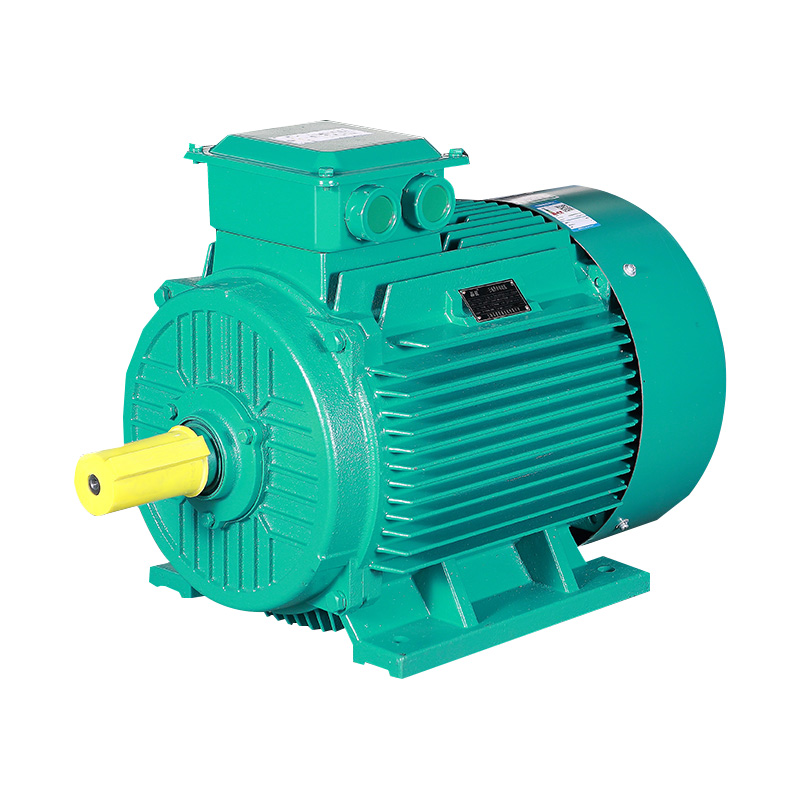
Therefore, when choosing between a VFD motor and a standard motor, it is essential to consider the specific application and the required frequency range. Standard motors are designed for constant frequency and constant voltage operation and cannot fully adapt to the speed regulation requirements of a VFD. Consequently, they cannot be used as VFD motors.

Get in Touch
Related Products
 Shanghai Pinxing
Explosion-proof Motor Co., Ltd.
-
 cai@pinxingmotor.com
-
 +86-21-57566731
-
 +86-21-57566967
-
 No.699, Pinxing Rd., Qinggang Industrial Zone, Fengxian District, Shanghai, China.(East Gate)
-
No. 168, Qingling Rd, Qinggang Industrial Zone, Qingcun Town, Fengxian District, Shanghai, China (South Gate)
Copyright@ 2024 Shanghai Pinxing Explosion-proof Motor Co., Ltd. All Rights Reserved.
Privacy