- 中文网站请点击 http://www.pinxinggroup.com
-
 +86-21-57566731
-
 cai@pinxingmotor.com
-
 DOWNLOAD


 English
 русский
 Français
 عربى
عربى
High Voltage Motor Efficiency: IE4 Standards and Selection Guide
Content
- 1 Direct Conclusion: Prioritize IE4 Efficiency and Thermal Resilience
- 2 Decoding the IEC 60034-30-3 Efficiency Framework
- 3 Insulation Systems: Mitigating Partial Discharge in VFD Applications
- 4 Industrial Performance and Application Metrics
- 5 Navigating Motor Standards: JB/T 14446 and Beyond
- 6 High Voltage Motor Manufacturing and Global Supply Chain
Direct Conclusion: Prioritize IE4 Efficiency and Thermal Resilience
For industrial users sourcing high voltage motors today, the immediate operational priority should be selecting units compliant with the newly defined IE4 Super Premium Efficiency class under IEC/EN 60034-30-3. While regulatory minimums are still phasing in, the economic case is mathematically settled: motors in the 200 kW to 2 MW range operating at IE4 levels reduce lifetime energy consumption by a verifiable margin compared to older IE2 or IE3 stock, often yielding a payback period of under 24 months in continuous duty applications . Furthermore, insulation integrity—specifically resistance to partial discharge—is non-negotiable for longevity. The reliable path forward is selecting insulation systems validated for high thermal class (Class H or higher) and optimized winding configurations to withstand the steep voltage rise times common in modern variable frequency drives.
Decoding the IEC 60034-30-3 Efficiency Framework
The landscape of high voltage motor efficiency is no longer ambiguous. The publication of IEC/EN 60034-30-3 provides the first harmonized global standard specifically for high voltage AC induction motors. This framework establishes clear benchmarks from IE1 (Standard Efficiency) up to IE4 (Super Premium Efficiency) for equipment operating between 1000 V and 11 kV .
Compliance with this standard is critical for energy-intensive sectors such as cement, metallurgy, and water conservancy. The standard covers the power range of 200 kW to 2 MW, directly aligning with the workhorse equipment used in large-scale industrial drives. While the European Union and other major markets are expected to enforce IE3 or IE4 as energy performance standards (MEPS) within the decade, proactive selection of IE4 motors now offers a hedge against regulatory risk and immediate reduction in total cost of ownership. Top-tier manufacturers have demonstrated efficiency benchmarks reaching 96.91% in controlled testing, proving that even marginal gains in this high-power bracket translate into significant kilowatt-hour savings annually .
Insulation Systems: Mitigating Partial Discharge in VFD Applications
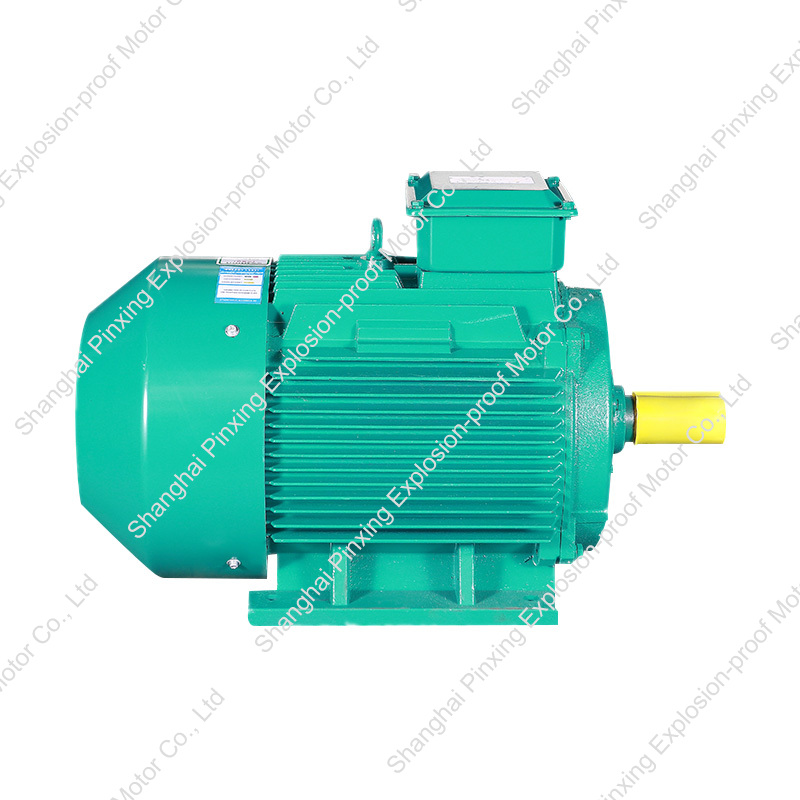
The reliability of a high voltage motor is predominantly defined by its insulation system, particularly when paired with inverters. The primary failure mechanism in modern high voltage induction motors is partial discharge (PD)—a localized dielectric breakdown of the insulation due to voltage spikes. Recent advances in material science have shifted the industry away from traditional mica tape alone toward nanocomposite insulation technology .
By dispersing nanoparticles uniformly within the mica tape matrix, manufacturers can now reduce insulation layer thickness while simultaneously increasing the Partial Discharge Inception Voltage (PDIV). Data indicates that applying such technology can reduce copper loss by approximately 20% and improve overall efficiency by 0.2% due to increased slot fill factor . For end-users in the petrochemical or mining sectors where motors operate in potentially explosive atmospheres, these enhanced insulation properties are particularly critical. This advancement directly complements the rigorous safety requirements of increased safety and flameproof motor enclosures, ensuring that the coil insulation remains intact even under thermal stress beyond Class 155 (F) or Class 180 (H) limits.
Industrial Performance and Application Metrics
High voltage AC motors are the prime movers in applications where torque demand and operational continuity are non-negotiable. The following table details typical performance and application parameters based on aggregated industry data and standard frame sizes, providing a reference for sizing and specification.
| Application Sector | Typical Power Range (MW) | Common Voltage Class (kV) | Critical Selection Factor |
|---|---|---|---|
| Cement & Mining | 0.4 – 8.0 | 6.0 / 10.0 | High starting torque / Dust ingress protection |
| Water & Wastewater | 0.2 – 2.0 | 10.0 | Continuous duty efficiency (IE4) |
| Metallurgy | 1.0 – 20.0 | 6.0 / 10.0 | Overload capacity & thermal resilience |
| Power Generation | 2.0 – 40.0 | 11.0 / 13.8 | Grid code compliance / Rapid response |
Specifying engineers must navigate a complex matrix of international and national standards. The recently implemented industry standard JB/T 14446-2025 provides a technical specification and energy efficiency grading framework specifically for 10 kV high voltage three-phase asynchronous motors with frame sizes 400 to 630 . This standard serves as a critical benchmark for ensuring that motors deployed in the Chinese market—and those exported globally from Chinese manufacturing bases—meet rigorous performance and reliability thresholds.
For global applications, adherence to the IEC 60034 series is essential, particularly regarding:
- Cooling methods (IC Codes) to ensure adequate heat dissipation in high-altitude or tropical environments.
- Degrees of protection (IP Codes) ranging from IP55 to IP65 for dusty or wet locations common in cement plants and mines.
- Vibration severity limits to prevent premature bearing failure in high-speed (2-pole/4-pole) configurations.
Manufacturers with in-house testing capabilities for these parameters provide a distinct advantage by ensuring that the motor's performance curve matches the driven equipment's demand profile from day one.
High Voltage Motor Manufacturing and Global Supply Chain
The production of reliable high voltage induction motors requires integrated manufacturing capabilities that span casting, coil winding, vacuum pressure impregnation, and precision machining. Suppliers specializing in this vertical, such as Shanghai Pinxing Explosion-proof Motor Co., Ltd., maintain portfolios exceeding 1000 varieties of large and medium-sized high-voltage AC and explosion-proof motors. These products are deployed across more than 40 countries, supporting essential industries from coal mining to marine propulsion.
The shift toward "Energy Conservation, Efficiency, and Environmental Protection" is not merely a market trend but an engineering imperative. Advanced manufacturing processes now incorporate digital twins of the stator winding and rotor balancing to reduce mean time between failures. For end-users, partnering with a supplier that operates as a true technology solution provider—rather than just a component vendor—ensures access to the latest advancements in high-voltage flameproof motor design and integrated automation. This holistic approach is essential for uptime in critical processes where the cost of motor failure far outweighs the initial capital expenditure on premium efficiency hardware.

Get in Touch
Related Products
 Shanghai Pinxing
Explosion-proof Motor Co., Ltd.
-
 cai@pinxingmotor.com
-
 +86-21-57566731
-
 +86-21-57566967
-
 No.699, Pinxing Rd., Qinggang Industrial Zone, Fengxian District, Shanghai, China.(East Gate)
-
No. 168, Qingling Rd, Qinggang Industrial Zone, Qingcun Town, Fengxian District, Shanghai, China (South Gate)
Copyright@ 2024 Shanghai Pinxing Explosion-proof Motor Co., Ltd. All Rights Reserved.
Privacy